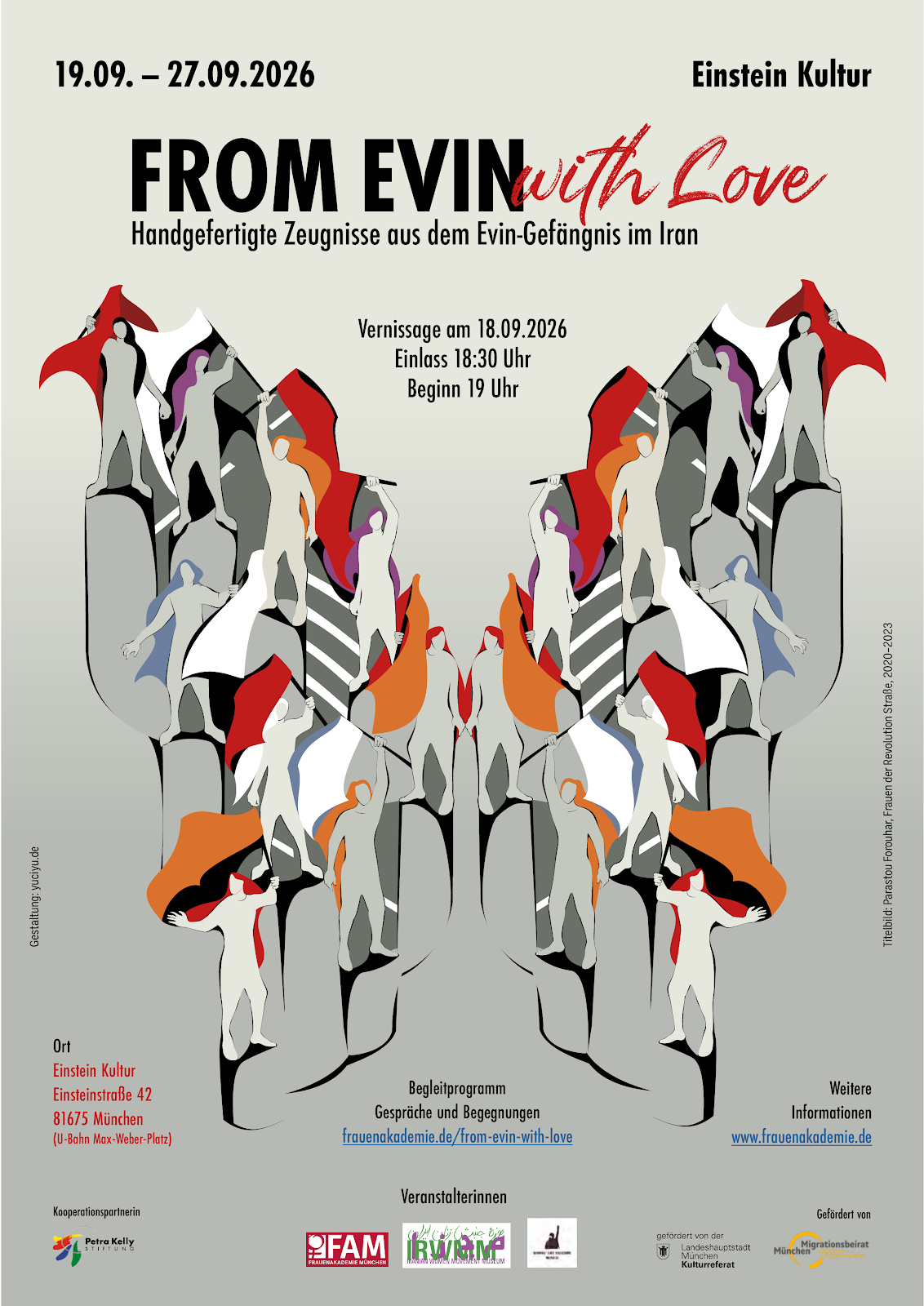
From Evin for Woman, Life, Freedom: September 18 to 27.
Preparing and Installation day
Sixty-one objects, sixty-one narratives, and sixty-one boxes were transported from The Hague to Munich in a rented van on 11 September, departing at seven in the morning. The van was driven by Amir, our volunteer driver, with Mansoureh as the “co-driver”. After a journey of around fourteen hours, the exhibition venue was reached at approximately nine in the evening.
The boxes were stored in the venue’s storage room until 13 September, when Parastou Forouhar arrived and the installation plan was discussed and decided upon.
Three full days were devoted to bringing the exhibition to life: from unloading and carrying boxes to ironing the black tablecloths, painting and installing the wooden poster stands, carefully placing each object in its designated box — boxes entrusted with protecting the objects and keeping them safe throughout their journeys until they reach their final destination — and attaching the captions beside each object.
From heavy lifting to ironing, rope-pulling, painting, and installation, three full days of work were needed to complete everything.
Three full days of enjoyable work, shared laughter, and unforgettable memories were shared by a team of six ,)Parastou, Mansoureh, Birgit, Bahram, Gabriele Muler and Sophia Schumann) as captured in the following photographs.

Opening event
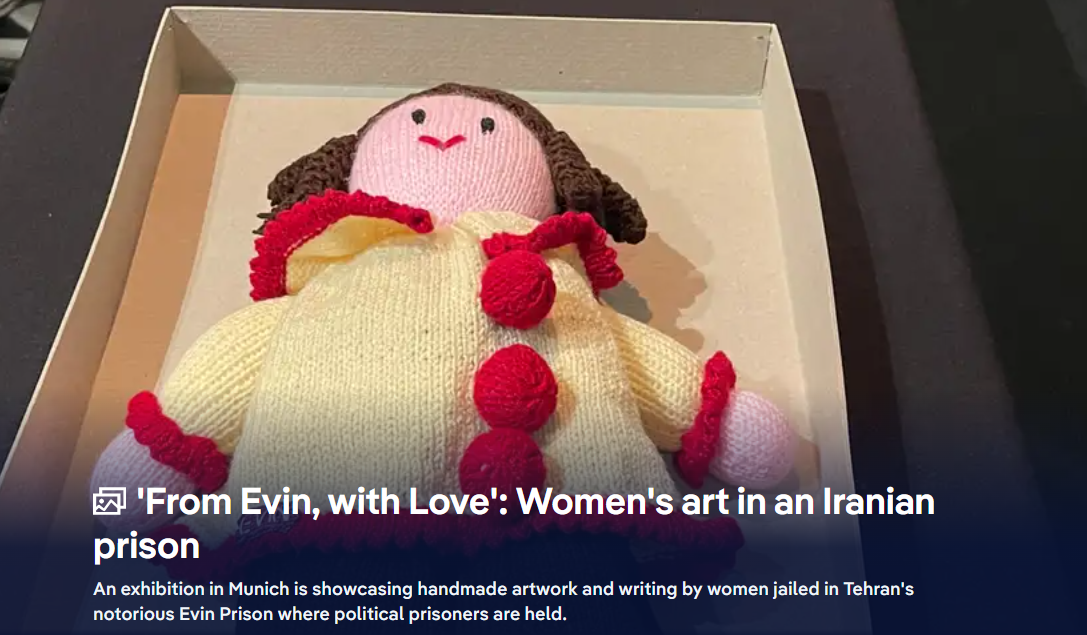
While the international spotlight often focused on geopolitics, a quiet yet powerful form of resistance made by Iranian women political prisoners found its voice on a European stage. Handmade dolls, paintings, carpets, wooden frames, leather bags, and personal objects crafted by women political prisoners over the past decade were put on public display in Munich, Germany. The "From Evin with Love" exhibition brought together these tangible artifacts, conveying deeply personal narratives of imprisonment, resilience, and hope alongside mementos from the "Woman, Life, Freedom" movement.
Marking the fourth anniversary of the "Woman, Life, Freedom" uprising, the exhibition showcased a unique collection of handicrafts produced by female political detainees in Iran. It opened on Friday, September 18, at the Einstein Kultur gallery in Munich and ran through September 27. The items on display had been created over the previous 10 years and had been gathered as part of an initiative by the "Museum of Iranian Women’s Movement."
The exhibition was curated by Mansoureh Shojaee, a women’s rights activist and researcher, and Parastou Forouhar, an artist and political activist. The edition in Munich was organized in collaboration with the "Frauenakademie" (Women's Academy) and the "Woman, Life, Freedom Association Munich."
At the opening ceremony in Munich, visitors entered the hall guided by placards bearing slogans from the "Woman, Life, Freedom" movement, Set against the ambient sounds of traditional lullabies, interwoven with the anthems and chants of the Woman, Life, Freedom movement, alongside sound effects and lullabies.
Inside, hand-sewn dolls, leather bags, carved wooden frames, paintings, a hand-woven carpet, and other personal items were displayed. Organizers emphasized that these objects had been smuggled out of Evin Prison and now told the stories of the lives, struggles, and personal experiences of female political prisoners.
Vida Rabbani, who had been scheduled to speak at the Munich opening, was unable to attend after being denied a German visa. She instead shared a video message explaining the background of her painting.
In her message, Rabbani explained that the courtyard depicted in her painting was the exact spot where remaining prisoners bid farewell to those being released. She recalled seeing off fellow activists and researchers, including Sepideh Kashani, Niloufar Bayani, and Sepideh Gholian.
The opening programme began with a warm welcome from Birgit Erbe, Director of the Women’s Academy. In her opening remarks, Birgit highlighted the significance of the Woman, Life, Freedom movement and the importance of standing in solidarity with it. She also expressed her gratitude to everyone who had contributed voluntarily to the exhibition, including both Iranian and German volunteers.
This was followed by a video message from Hannah Neumann, Member of the European Parliament.

Neumann addressed the ongoing repression of protests in Iran, framing the exhibition as proof of the Iranian people's enduring spirit of resistance. She urged Western policymakers to move beyond words, support activists on the ground, and ensure that perpetrators of state atrocities were brought to justice. Concluding her remarks, Neumann thanked Shojaee, Forouhar, and Erbe, describing "From Evin with Love" as a direct continuation of the movement that had started on the streets of Tehran and had now reached Munich.
Birgit then invited Mansoureh Shojaee to the stage to deliver her speech. In one part of her address, Mansoureh Shojaee, reflected on the history of the project since its establishment in Iran in 2009. Shojaee contextualized the exhibition within the broader trajectory of Iranian protest movements and state repression, referencing events from the 2009 Green Movement to the protests of January 2026, as well as the escalation of military conflicts involving Israel and the United States against Iran.

During her opening address, Mansoureh reflected on the origins and significance of the exhibition and connected the stories of women prisoners with the broader history of the "Woman, Life, Freedom" movement:
"Someone wrote from the bloodied streets…
I remember it was around the fortieth day after Jina’s death… Yes, someone wrote:
'In that hospital, we left behind a body that was not the innocent body of Mahsa. Her body carried home and was buried with magnificent dignity in Kurdistan. But another body was left behind in the corridors of Kasra Hospital in Tehran—a body that would never come out again: the body of fear, and obedience…'
Born as a beautiful expression of resistance within Iran's women's movement, the Mahsa movement did not remain theirs alone; it shared its beauty and power with every woman and man who gave a body to Woman, Life, Freedom.
And how fitting that, to mark the fourth anniversary of the Woman, Life, Freedom movement, we are holding this exhibition in Munich."
Shojaee explained that the exhibition of handmade works created by women prisoners in Evin Prison was the first project of the Iranian Women’s Movement Museum. She said it had never been intended to offer a complete account of the women’s movement in Iran, but rather a glimpse of its struggles, resilience, and resistance over the previous eighteen years.
………
"We incorporated these works into its growing collection of objects created by women activists and prisoners. In doing so, the conceptual framework of the exhibition expanded from the place of resistance to the space of resistance: from Evin as a specific site of imprisonment and resistance to the wider, often invisible spaces in which resistance continues to take shape."
Shojaee then recalled her own experience of interrogation and the threats she had received over the exhibition for women.s museum in Iran 2010.:
She then connected that memory of imprisonment and fear to the more recent violence experienced in Iran.
"The memory of prisoners suddenly waking in terror, night after night, in the prisons of those years had never faded. But since midnight on June 13, 2025, when Israel attacked Iran, those haunting prison nights have become the unending midnight of the Iranian homeland.
The subsequent U.S. attacks, carried out under the pretext of humanitarian concern and in clear violation of international law, have deepened the devastation of Iranian lives, homes, and souls, day after day, night after night.
The other side of this fear is the Islamic Republic and its Revolutionary Guards—whose violence, carelessness, and disregard for the people have helped drag Iran into this war. After decades of uranium enrichment, they have brought Iran neither security nor prosperity."
Shojaee concluded her speech by outlining what she described as a "third way":
A third way that says:
Let the war end.
Let justice put bread on people’s tables.
Let the executions end.
Let the prison doors open for political and religious prisoners.
A way that says: Woman. Life. Freedom."
The next speaker was Parastou Forouhar, artist, co-curator, and board member of the International Women’s Museum Movement.. She began her speech by describing these small, beautiful objects as carrying the hope of realising a great and collective dream: the establishment of a Women’s Movement Museum in Iran:

The exhibition we have gathered here to open today is a small, beautiful sign on the path toward a great idea and a great hope: the creation of a museum that can make the history and diversity of the women’s movement in Iran visible and tangible.(…..)
Such an undertaking was and remains a difficult task. Like every great idea, this museum can remain alive only if we understand it as something open and unfinished—as a process that explores the past with curiosity and respect while also taking in the diversity of the present.
For the history of women in Iran is made up of different experiences, voices, and forms of action. It tells of courage and perseverance, but also of repression, loss, and injury. A museum devoted to this history must therefore also be a place where these contradictions can be made visible side by side.
The exhibition “From Evin with Love” is one such glimpse.
Parts of Parastou’s speech focused on the handmade objects created by women prisoners and the narratives these objects carry with them as they travel from one country to another, crossing borders and connecting different places and lives:
It is conceived as a travelling exhibition and has already been shown in several places. With each presentation, it changes a little, takes on new elements, and enters into a new spatial and social context. Its journey from place to place is therefore also part of its history…….
This exhibition is small. But perhaps precisely for that reason, it can open something: a small window, a space for empathy and solidarity.
And perhaps it can also show that an archive does not always have to consist of large institutions, monumental documents, or complete collections.
Sometimes an archive begins with a cardboard box.
With an object that someone kept.
With a poster that someone drew for a demonstration.
With a memory passed from one person to the next.
And with the decision not to let these things disappear.
Take your time with these small things, with their stories, and with the images that speak to us from the public space of the protests.
……
In this comprehensive context of the destruction of life, the works in this exhibition acquire a particular resonance. They tell not only of a situation in the past. They also point to a present in which freedom, dignity, and the possibility of determining one’s own life continue to be contested.
And perhaps that is the deeper meaning of the title “From Evin with Love.”
The love in this title is not a romantic idealisation. It refers to a persistent form of human connectedness—the refusal to give up relationships and care where repressive power structures attempt to isolate and degrade people.
A doll for a child.
A scarf.
A bag.
A poster from the protest movement.
These are different forms, but they carry something in common: the assertion of human presence: I am still here. Do not forget me. Do not forget what remains between us.
This assertion is directed toward another person. It calls on us not merely to perceive, but to maintain the connection to these people and their stories. The exhibition therefore seeks to make the boundary between perception and action permeable.

To conclude the opening programme, Laleh, a member of the Woman, Life, Freedom Association in Munich, introduced the association and its work. Birgit then invited the audience to visit the exhibition.
Copyright Fotos: Barbara Hartmann

Accompanying Programme
The exhibition’s accompanying programme included two panel discussions: one on feminist and decolonial cultures of remembrance, and a feminist roundtable on activism, solidarity, and current issues. The programme also featured a book-launch panel for Mapping Gender Struggles, a screening of the film My Stolen Planet, and a concert on the closing night. :
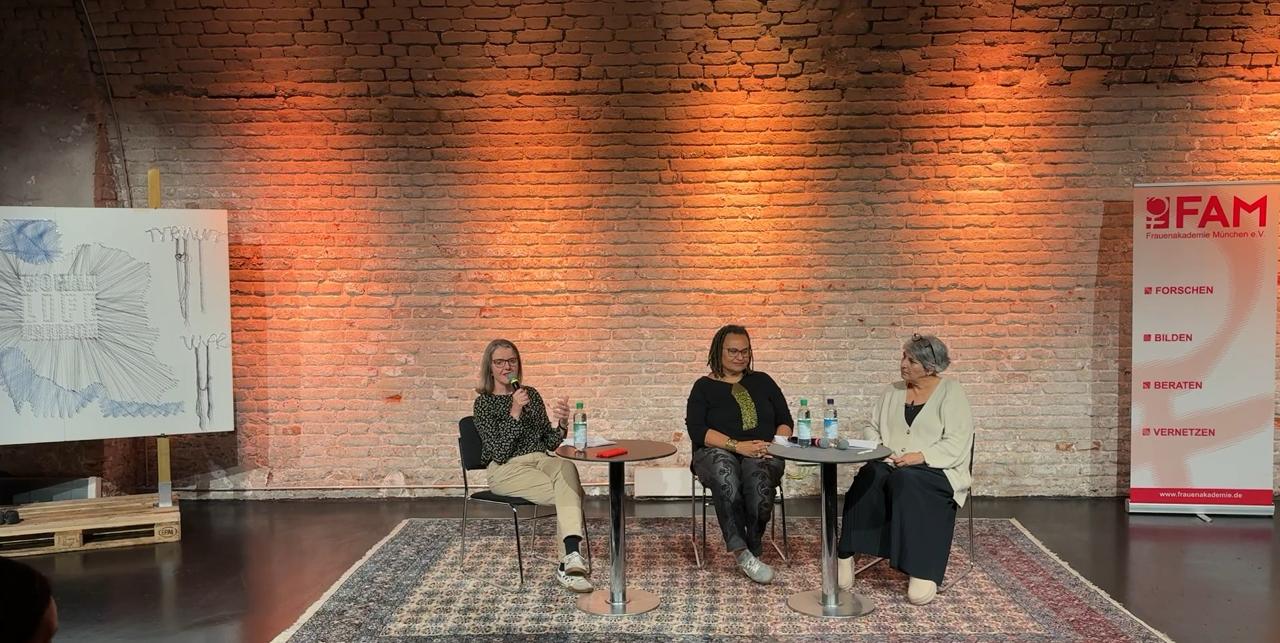
19 September 2026 | Feminist and Decolonial Cultures of Remembrance
A conversation between Parastou Forouhar and Anke Büttner, moderated by Birgit Erbe.
24 September 2026 | Film Screening: My Stolen Planet
A screening of My Stolen Planet, directed by Farahnaz Sharifi, followed by a discussion with the audience about the film and Iranian cinema as a form of protest and resistance.
25 September 2026 | Feminist Roundtable: Activism, Solidarity, and Current Issues
The roundtable brought together Gaby Franger, Director of IAWM and a scholar, Carolyn Schniede, Nina Reggi, and Maryam Shirin Sokhan for a discussion on feminist activism, solidarity, and current challenges. The discussion was moderated by Ananya Mehra.

The evening continued with a DJ set by Funky Francis, who presented a selection of music that brought the programme to a lively close.
26 September 2026 | Book Launch Panel: Mapping Gender Struggles
The event opened with an introduction to the book by its editors, who are colleagues at the Women’s Academy Munich.

The programme continued with a conversation entitled Is Revolution Feminine? between Mansoureh Shojaee from Iran and Olga Shparaga from Belarus, moderated by Birgit Erbe.
At the end of the event, copies of Mapping Gender Struggles were available for purchase by the audience.

Closing Programme | 27 September 2026
The closing programme began with an exclusive guided tour for colleagues and supporters of the Women’s Academy Munich, as well as members of the public.
Among the visitors were several former political prisoners who had been imprisoned in Iran during the 1980s. At the organisers’ invitation, they shared brief personal memories of their time in prison with the German visitors.
The visit became an interactive exchange between visitors and the exhibition organisers, bringing the exhibition’s objects, histories, and personal narrations to life. Through these shared memories and reflections, the exhibition space became a place of encounter and emotional connection, where individual experiences of imprisonment and resistance could be heard, felt, and understood across different backgrounds and generations.
At the end of the visit, Birgit Erbe once again thanked everyone involved in organising the exhibition, as well as the volunteers whose commitment and contributions had helped make it possible.
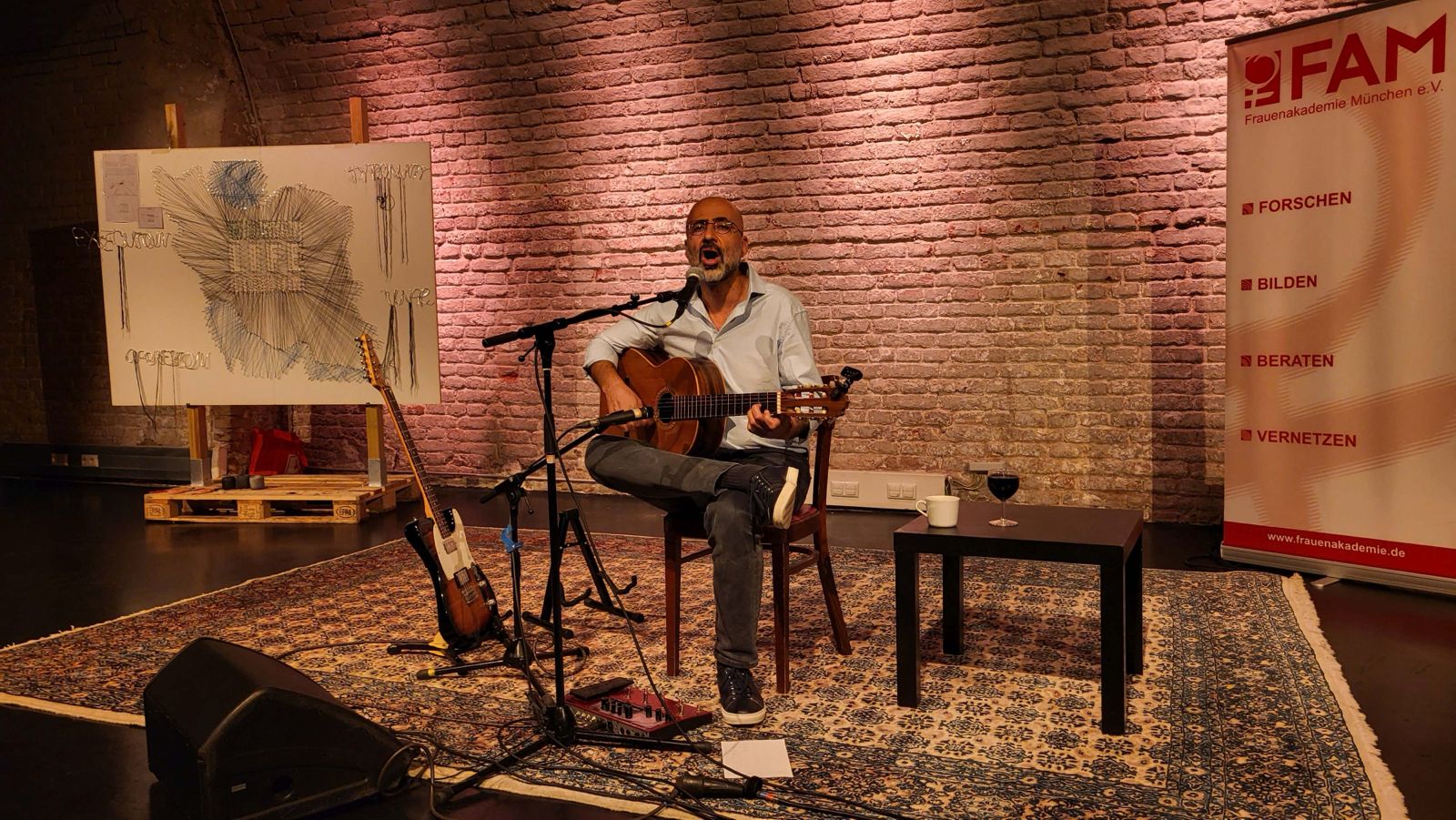
The programme concluded with a musical performance by Arash Sassan, an Iranian-German musician, guitarist, and singer. He opened his performance with a memorable anthem associated with earlier generations of Iranian freedom fighters, evoking shared memories of struggle and resistance. He then performed a selection of Iranian songs, bringing the exhibition to a moving and memorable close.
Exhibition Gallery

Dismantling and Packing Up the Exhibition
On 28 September, we dismantled the exhibition and packed everything: some items for display at the Women’s Museum in Bonn, and the rest to be stored in The Hague.
Tired but happy, and grateful for the collaboration and support we shared, we closed the boxes and set off on another journey…

In media
From Evin to Munich with "Woman, Life, Freedom"
View this post on Instagram
View this post on Instagram
View this post on Instagram